Best Pull-Up Bars 2026
Pull-up bars offer one of the highest returns on investment in home gym equipment. We compared doorway, wall-mounted and freestanding options on rated weight capacity, mounting requirements, grip positions and the doorframe dimensions each one needs.
Types of Pull-Up Bars
Doorway bars require no installation and fit standard door frames (60–90 cm width). Most rated to 100–135 kg. Lever-style bars are more stable than telescoping models and less likely to damage door frames when used correctly.
Wall-mounted bars require drilling into studs or concrete but offer higher weight capacity, more grip positions and permanent installation suited to dedicated training spaces. Best long-term option for home gyms.
Freestanding racks with integrated pull-up bars offer the most versatility — squats, presses and pull-ups in one unit — but require the most space and upfront cost.
Training you repeat, and protein you actually hit
A pull-up bar is a one-time purchase under $100. What it cannot do is supply the two things that decide whether you ever add a rep.
Consistent training is the first. The second is protein, and it is the one people miss: the range this site lands on for people who train regularly is 1.6–2.2 g per kg of bodyweight per day — 112–154 g for someone at 70 kg. Hitting that from food alone is the part most people quietly fail.
Our Top Picks
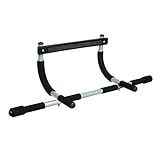
The Iron Gym remains the standard recommendation because it works consistently. The leverage-over-door design is more stable than telescoping competitors. Three grip widths cover wide, narrow and neutral pull-up variations. Add padding between bar and frame to protect door trim.

ProSource adds angled neutral-grip handles for hammer-grip pull-ups and chin-ups. Better choice if shoulder or elbow comfort is a priority. Slightly lower weight capacity than Iron Gym, but the grip variety justifies the trade-off for most users.

Solid wall-mounted construction with 25 cm of clearance for full ROM. Multiple grip positions and straightforward stud installation. Best mid-range option for dedicated home gym spaces. Must be mounted into studs — not drywall.
Frequently Asked Questions
Are doorway pull-up bars safe?
Yes, when used correctly. Lever-style bars distribute weight through the door frame and are safe up to their rated capacity. Avoid explosive kipping movements on doorway bars, which put more lateral stress on the frame. Check weight limits and add padding to protect the frame.
How many pull-ups should a beginner aim for?
Starting from zero, most adults progress from band-assisted pull-ups to 3–5 unassisted in 8 weeks. At 12 weeks of consistent training (3 sessions/week), 8–10 consecutive pull-ups is achievable for most healthy individuals.
What muscles do pull-ups train?
Pull-ups primarily work the latissimus dorsi, teres major and biceps brachii. Secondary muscles include the rhomboids, posterior deltoid, brachialis and core stabilisers. Wide-grip emphasises lats; narrow neutral-grip shifts more load to biceps and lower lat.
The full home gym list
Every bench, rack, dumbbell and band we recommend — collected in one list on Amazon.
See the full list on Amazon →