What You'll Learn
Table of Contents
Start With The Number
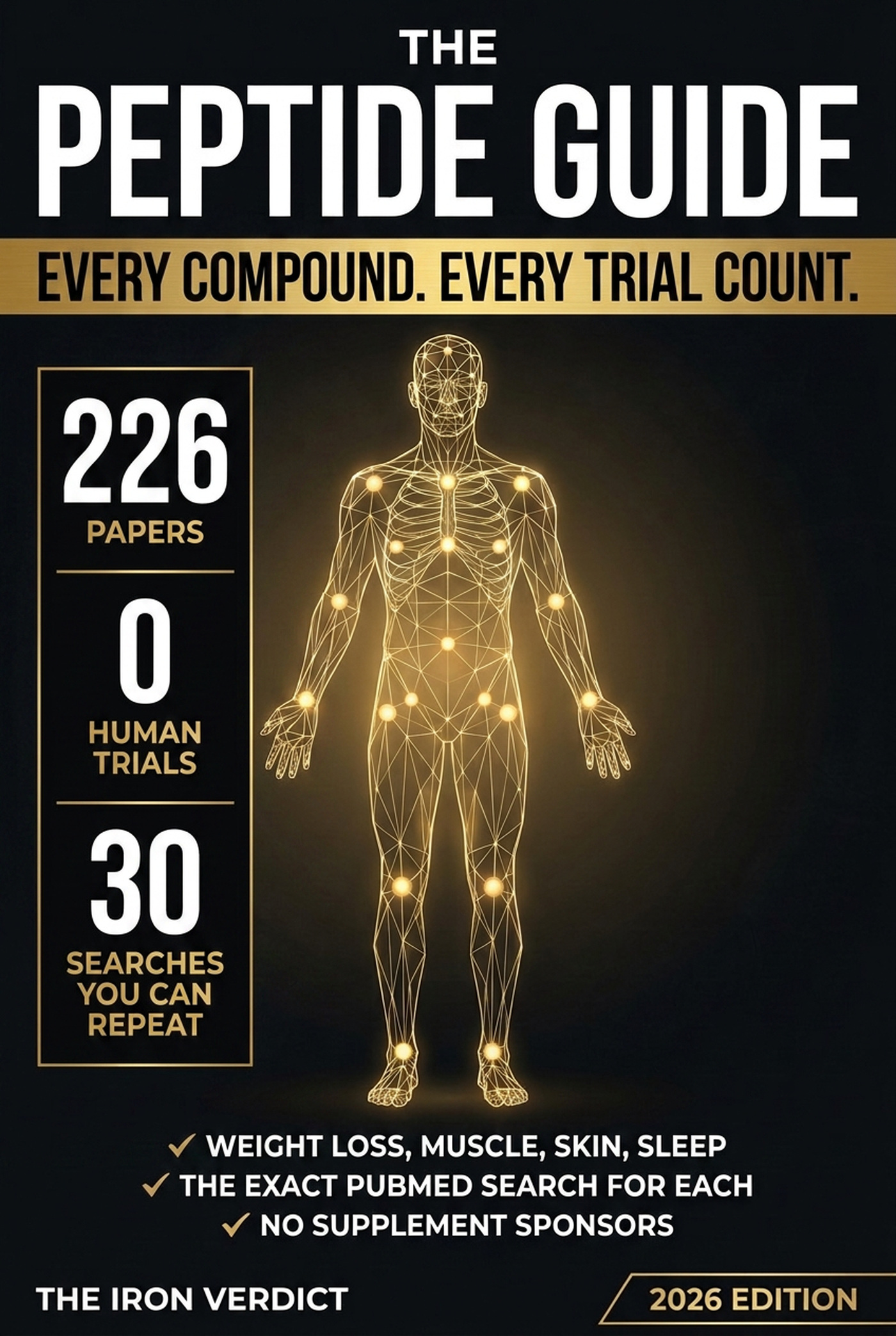
Search PubMed for BPC-157 and you get 226 records. That sounds like a research base. Filter for the randomised-controlled-trial publication type and you get zero.
Not few. Not small ones. None.
For comparison, run the same two searches on compounds with real development programmes:
- Cagrilintide: 95 records, 14 randomised trials
- Retatrutide: 167 records, 6 randomised trials
- BPC-157: 226 records, 0
- TB-500: 25 records under that name, 0 — but it is thymosin beta-4, and that pair returns 1,057 records and 7 randomised trials
- Epitalon: 62 records under that name, 0 — but widen it to epithalamin, the earlier pineal extract, and the pair returns 190 records and 6 randomised trials, largely older Russian work on the extract rather than the compound sold today
Notice the pattern, because it is the whole story of this field: the peptides marketed hardest to consumers have no randomised evidence, and the peptides with randomised evidence are pharmaceutical compounds you cannot lawfully buy.
A record count is not a quality measure. 226 papers on a compound with no controlled human trial is a literature about a molecule, not about a treatment.
The same query on cagrilintide returns 14 randomised trials and on retatrutide 6. The counts move as literature is indexed; the gap between zero and fourteen does not close by rounding.
Repeat the search ↗Bottom line: Anyone can check this in thirty seconds. Search PubMed for the compound, then add the randomised-controlled-trial filter. Do it for anything you are considering — it is the fastest honest test available to a non-specialist.
What The 226 Papers Actually Are
The bulk of the BPC-157 literature is animal work, most of it from a small number of groups, and much of it in rodent models of injury: tendon, ligament, gut, muscle. The findings in those models are often striking. That is the reason the compound has a following, and it is a genuine observation rather than a fabrication.
The difficulty is what animal results do and do not license you to say. A rat tendon model tells you a molecule does something in a rat tendon. It does not establish a dose, a route, a duration, a safety profile, or an effect in a human being — and the history of drug development is largely a history of compounds that worked beautifully in rodents and then did not.
A 2026 narrative review in Sports Medicine put the position across the whole class plainly: many unapproved peptides show favourable tissue-repair and metabolic outcomes in animal models, but rigorous human safety data are scarce, and there is potential for serious harm. The same review describes what has grown up around these compounds as a “gray market” operating largely outside regulatory oversight.
There is also a category of BPC-157 paper that tells you something about the field on its own: analytical-chemistry work on detecting it in doping tests. Methods papers exist because sporting bodies expect to find it in athletes.
Covers AOD-9604, BPC-157, CJC-1295, follistatin-344, GHK-Cu, ipamorelin, MOTS-c, sermorelin, SS-31, tesamorelin, thymosin beta-4 and TB-500. Notes favourable animal-model outcomes alongside scarce human safety data and potential for serious harm, and discusses placebo as a mediator of perceived effect, amplified by social media.
PMID: 41966639 ↗The Human Clinical Literature, In Full
Fifty-two BPC-157 records carry a human tag, which sounds substantial until you read them. Most are narrative reviews, editorial commentary, or the doping-detection methods above — papers about humans, not studies in them.
What remains, as of August 2026, is two pilot studies:
- A pilot on the safety of intravenous BPC-157 infusion in humans.
- A pilot on symptoms in patients with interstitial cystitis.
Both were published in Alternative Therapies in Health and Medicine, and they share authorship. Neither is randomised. Neither is placebo-controlled.
That is the entire human clinical record for a compound sold worldwide for tendon repair, gut health and injury recovery. Two small pilots, one journal, overlapping authors, and no control group between them.
A pilot study is a legitimate and necessary thing — it is how you find out whether a proper trial is feasible. It is not evidence that something works, and it was never meant to be.
Important: If a seller cites “human studies” on BPC-157, ask which ones. There are two, both pilots, neither controlled. That question separates sellers who have read the literature from sellers who have read the marketing.
Where The Regulator Has Put It
BPC-157 sits in category 2 of the FDA's list of bulk drug substances nominated for use in compounding — the category for substances that may present significant safety risks.
The agency's stated reasons, in its own words rather than a summary of them:
- Compounded drugs containing BPC-157 may pose risk for immunogenicity for certain routes of administration.
- They may have complexities regarding peptide-related impurities and characterisation of the active pharmaceutical ingredient.
- The FDA has identified “no, or only limited, safety-related information” for the proposed routes of administration.
Read the second one twice, because it is the one nobody discusses. It is not a statement about the molecule. It is a statement about what is in the vial — whether the peptide is what the label says, and what else came with it. For a substance produced outside pharmaceutical manufacturing controls, that is the risk you cannot assess by reading about the compound.
Category 2 is not a finding that BPC-157 is dangerous. It is a finding that the agency does not have enough information to say it is safe, which is a different statement and, for something injected weekly, not a reassuring one.
Why People Are So Certain It Works
Any honest account of this has to deal with the strength of the anecdote. People report real improvement, and they are not lying.
Three things make this a hard area to read from experience alone:
Injuries heal. Tendon and soft-tissue complaints improve over weeks to months with rest and load management. Anything taken during that window gets the credit, which is precisely what a control group exists to separate.
Injected treatments carry a strong placebo response. This is well documented across pain and musculoskeletal medicine: route, ritual, cost and expectation all move reported outcomes. The Sports Medicine review discusses placebo explicitly as a mediator of perceived peptide efficacy, and notes that social media amplifies it.
Nobody posts the null result. The person whose tendon did not improve does not make a video about it. What you see is the surviving half of the distribution.
None of this proves the compound inert. It explains why a mass of confident testimony can coexist with zero controlled evidence, and why the two are not in conflict.
What Would Change This Verdict
Worth being concrete, because a position that nothing could change is not a position. This one would move on:
- A randomised, placebo-controlled trial in humans with a defined injury, a pre-registered endpoint, and enough participants to detect a difference.
- Published in a journal with meaningful peer review, by a group without a commercial interest in the answer.
- Replicated somewhere else.
That is not an unreasonable bar. It is the ordinary bar, and it is the one the cagrilintide and retatrutide programmes are currently clearing in public.
Until then the accurate statement is not “BPC-157 does not work.” It is: after twenty-some years and 226 papers, nobody has run the study that would tell us. Anyone selling it is asking you to bet on animal data and testimony, and the honest ones will say so.
If your interest here is injury recovery, the parts with actual controlled evidence behind them are unglamorous and already on this site: progressive loading, adequate protein, and sleep.