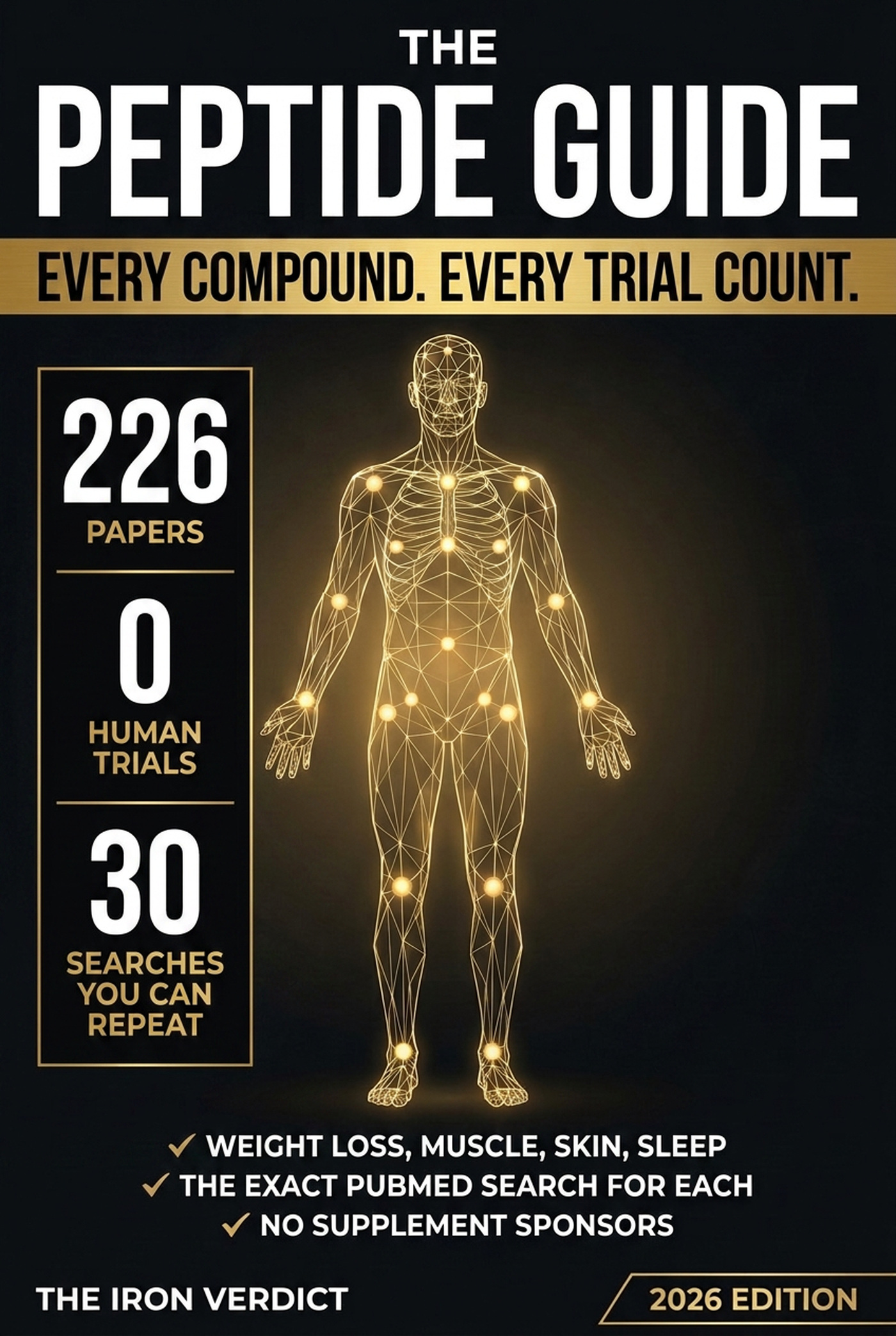
226 papers.
Zero human trials.
That is BPC-157, the most talked-about peptide in the gym. The papers are real. Not one of them is a randomised trial in a human being — the entire human record is two small uncontrolled pilots.
You can verify that in under a minute, and this book shows you how. It prints the trial count for every major peptide alongside the exact PubMed search that produced it, so you never have to take anyone's word for anything. Including mine.
Secure checkout by Payhip. Card or PayPal. If it is not what you expected, ask for a refund — handled by Payhip, no argument.
63-page PDF · instant download
24 live PMID links
Everyone says evidence-based. Nobody prints a number.
The best-selling peptide book on Amazon has "Science-Backed" in its title and "no hype, no fluff" in its description. It does not contain a single figure a reader can go and check.
That is the whole of the difference. A claim you cannot verify is a claim you are being asked to trust, and this field runs on people asking you to trust them — sellers, forums, podcasts, and the study abstract someone screenshotted without reading the methods.
Seven rows from the table at the back
The book counts randomised controlled trials in humans for nineteen compounds. Here are seven of them.
| Compound | PubMed records | Randomised human trials |
|---|---|---|
| Cerebrolysin | 633 | 62 |
| Cagrilintide | 95 | 14 |
| TB-500 as thymosin beta-4 same molecule as the row below | 1,057 | 7 |
| Retatrutide | 167 | 6 |
| Ipamorelin | 54 | 2 |
| TB-500 that name only same molecule as the row above | 25 | 0 |
| BPC-157 the entire human record is two uncontrolled pilots | 226 | 0 |
Note the two TB-500 rows. Same molecule, counted twice, because the name on the vial is not the name in the literature. Search the one on the label and you get 25 records and no trials. Search it as thymosin beta-4 and you get 1,057 records and seven trials.
Neither number is wrong. Whichever one you find decides what you believe, and almost nobody checks that they have both. That trap is why the searches are printed in the book rather than described.
There are no doses in this book
No schedules, no protocols, nothing about obtaining anything. It is a book about how to tell what is known from what is asserted. If you have a decision to make about your own treatment, that conversation belongs with a clinician who can examine you.
What is in it
How to read this field
- The question that settles most arguments
- How to run the search yourself
- What a trial count cannot tell you
- Regulatory language, decoded
The compounds
- BPC-157 — 226 papers, zero randomised trials
- Growth hormone peptides — 42 trials, and they answered the wrong question
- Longevity peptides — three ways an evidence base looks bigger than it is
- Skin peptides — the trials were run on dogs and horses
- Nootropic and sleep peptides — 62 trials, and that is the bad news
- Retatrutide — the chapter where the evidence is real
- Cagrilintide — fourteen trials, and 0.16 percentage points
The buyer's position
- What is actually approved
- If you are going to anyway
- What would change any of this
Part I is the part that keeps working after you have finished. It hands you a method that applies to any claim about any compound — including the ones this book does not cover, and including books that disagree with this one.
It is not an argument that peptides do not work
A book that could not tell a compound with fourteen randomised trials apart from one with none would be worth nothing.
So chapter 10 reports one of the largest weight-loss results ever published, and says so plainly. Chapter 11 covers a compound with fourteen randomised trials behind it. Chapter 12 lists what has actually finished the approval process, and what it was approved for, which is usually not the thing it is sold for.
Two of the claims in this field survive contact with the evidence. The book is specific about which two.
Questions
Is this a protocol manual?
No. There are no doses in it, no schedules, and nothing about where to obtain anything. It is about which claims survive contact with the evidence.
Does it argue that peptides do not work?
No, and a book that did would be useless. Chapter 10 reports one of the largest weight-loss results ever published, and chapter 12 lists the compounds that have finished the approval process. The point is telling those apart from the ones with nothing behind them.
Can I check the numbers?
That is the design. Every count is printed with the exact PubMed query that produced it, and the 24 PMIDs are live links. Where the book and PubMed disagree, PubMed is right and the book is out of date.
Will the counts go out of date?
Yes, and the book says so on the first page. Every number is dated to August 2026. That is the cost of being specific instead of vague, and the searches are printed so you can re-run any of them in a minute.
What format is it?
A 63-page PDF, downloadable the moment you buy. It reads on a phone, and the reference table at the back is one page.
63 pages. Every count dated, every search printed, 24 live PMID links. Instant PDF.
Get The Peptide Guide — $9Secure checkout by Payhip. Card or PayPal. If it is not what you expected, ask for a refund — handled by Payhip, no argument.
From The Iron Verdict. No supplement sponsors, and no affiliate links on anything discussed in the book.