What You'll Learn
Where we send readers now
We no longer earn commission on any competing supplement brand on this page. The only supplement link we earn from is Legion, below — so you can weigh our ranking above knowing exactly where our money comes from.
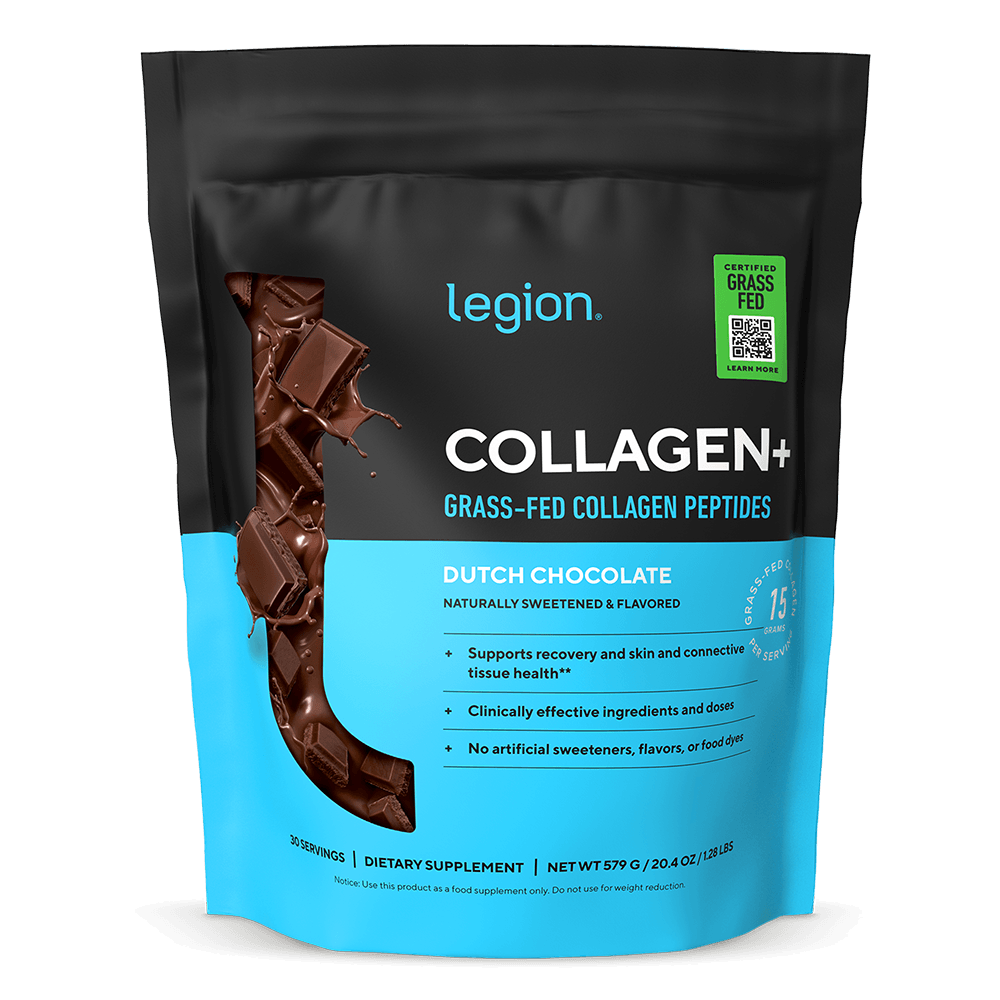
- Grass-fed collagen peptides
- Every dose disclosed
Disclosure: The Iron Verdict earns a commission on purchases made through the Legion link and code above, at no extra cost to you. We were not paid to rank any product on this page, and the ratings above were written before this partnership existed.
Table of Contents
Why This Category Is Different
Everything else on this site's peptide pages describes something injected, unapproved, and mostly unpurchasable. Topical skin peptides are the opposite: they are cosmetics, sold on any high street, entirely legal, and you can buy the exact ingredient the studies used.
That is worth stating plainly, because the word “peptide” now carries the grey-market associations of the injectable side of this field. A copper peptide serum has nothing to do with that. Different molecule, different route, different regulator, different risk.
What it shares is the gap between the strength of the marketing and the strength of the evidence — and here the gap runs in a direction that will surprise most people.
Copper Peptide, When Somebody Tested It
GHK-Cu — copper tripeptide-1 — is the ingredient this whole category is built on. Search PubMed for it and its synonyms and you get 258 records, which is why every product page can cite “extensive research”.
Three carry the randomised-controlled-trial publication type. The one that tested it on human faces was published in 2006, in Archives of Facial Plastic Surgery, on skin after CO2 laser resurfacing. Patients were randomised to a post-treatment regimen with or without GHK-Cu, with blinded evaluators and computer analysis.
Thirteen patients completed it.
The results, in the authors' terms:
- No significant difference between groups in resolution of redness.
- Objective evaluation found no significant improvement in wrinkles or overall skin quality.
- Everyone improved — both groups — because the laser worked.
- The patient questionnaire did show a difference in perceived overall skin quality, P=0.04.
Read that last pair together, because it is the cleanest illustration of the whole peptide field in a single study. The instruments found nothing. The people using it felt a difference and reported one.
Both of those are real results. Only one of them is an effect on skin.
Copper tripeptide complex on CO2 laser-resurfaced skin. No significant reduction in post-treatment erythema and no significant improvement in wrinkles or skin quality on objective evaluation. Patient-reported overall skin quality differed at P=0.04.
PMID: 16847171 ↗The Other Randomised Trials Were In Animals
If three randomised trials sounds like a reasonable base, it is worth knowing what the other two are.
Both are veterinary dermatology. One from 2006 evaluating topical tripeptide-copper complex and zinc oxide; one from 2008 on topical tripeptide copper complex and helium-neon laser in wound healing. Published in Veterinary Dermatology.
A fourth randomised trial exists from 1992, in the Journal of Vascular Surgery, evaluating wound-healing agents.
So the randomised human evidence for copper peptide as a cosmetic is one 2006 study in 13 people that found nothing on objective measures. The rest is animal work, surgical wound healing, and a large body of laboratory research on what the molecule does to cells in a dish.
The cell biology is genuinely interesting — GHK-Cu does measurable things to collagen synthesis and gene expression in culture. That is why the ingredient exists. It is not the same as evidence that a serum containing it changes a face, and the distance between the two is where the entire marketing budget lives.
Argireline: Same Number Of Trials, Better Ones
Acetyl hexapeptide-8, sold as Argireline, is the ingredient marketed as “topical Botox” — a claim worth ignoring on its own terms, since botulinum toxin is injected into muscle and a serum sits on the surface.
The mechanism proposed is that it interferes with the SNARE complex involved in neurotransmitter vesicle docking, reducing the muscle contraction that creates expression lines.
It has 45 records to copper peptide's 258 — and, awkwardly for a neat story, the same number of randomised trials: three. So the case for it is not that there are more. It is what one of them did. That trial appeared in the American Journal of Clinical Dermatology in 2013: 60 subjects randomised 3:1 to argireline or placebo, applied to peri-orbital wrinkles twice daily for four weeks.
What separates this from the copper study is that it had a real objective endpoint. Silicone replicas were taken of the skin before and after and analysed by a wrinkle-analysis apparatus.
- Subjective assessment: anti-wrinkle efficacy 48.9% against 0% on placebo.
- Objective measurement: all roughness parameters decreased in the argireline group (p<0.01); no obvious decrease on placebo (p>0.05).
That is a positive randomised result with an instrument-measured endpoint. Set it beside the copper study — which had blinded evaluators and computer analysis and found nothing on those measures — and the difference between the two ingredients is not how many trials exist. It is that one measured the skin and got an answer, and the other measured the skin and got nothing.
Keep it in proportion: 60 people, four weeks, one population, 3:1 randomisation so only about 15 on placebo, and one study. It is not a large or replicated evidence base. It is simply a better one than the ingredient with four times the papers and twenty times the marketing.
Bottom line: The pattern to take from this: the number of papers on an ingredient tells you how interesting the molecule is to researchers. It tells you nothing about whether the product works on a face. Only a trial with an objective endpoint does that.
If You Are Buying One Anyway
The honest ranking follows the evidence above rather than the marketing, which means it is not the order these are usually sold in. Prices are low enough across the category that none of this is a big financial decision either way.
1. An argireline serum, if you want the one with a measured result
The 2013 trial used acetyl hexapeptide-8, so a product that names the ingredient and its concentration is the closest thing to what was tested. Skin Deva Argireline Peptide Serum states the peptide on the label. Skin Deva 20% Argireline with Matrixyl 3000 combines it with the other ingredient in this article that has a trial.
2. Matrixyl, if you want the single-ingredient version
Palmitoyl pentapeptide has one randomised trial, which is one more than most cosmetic ingredients. Timeless Matrixyl 3000 Peptide Complex is a plain formulation rather than a twelve-ingredient blend, which at least makes it clear what you are testing on yourself.
3. Copper peptide, knowing what you read above
If you want it regardless — and plenty of people do, and the satisfaction data says they will enjoy it — Asterwood Copper Peptides GHK-Cu states its concentration, which most do not. Buy it having read the 13-person trial rather than instead of reading it.
None of these will do what a retinoid and daily sunscreen do, and all three cost less than one bad decision in a pharmacy.
Bottom line: These are affiliate links, which is disclosed at the top of every page on this site. They do not change what the article says: the copper trial found nothing on objective measures whether or not anyone buys a bottle through this page.
What “Cosmetic” Actually Means Here
The reason this category can make claims a drug could not is regulatory, and it is worth understanding once.
A cosmetic is regulated for safety, not for efficacy. A serum has to not harm you. Nobody requires evidence that it does what the box says before it goes on sale.
This is why cosmetic claims are written the way they are: appearance of fine lines, look of firmness, helps skin feel. Those are carefully chosen. A claim to change the structure or function of skin would make the product a drug and trigger a wholly different approval requirement.
So the absence of good efficacy trials in this category is not an oversight or a conspiracy. There is simply no regulatory reason to run one, and they are expensive. Companies that do run them are choosing to.
The practical consequence: “clinically proven” on a cosmetic box can mean a manufacturer-run consumer-perception study in 30 people with no control group. It is not the same phrase you read on a medicine.
How To Read A Serum Label
Three things worth knowing, all of them free.
Position in the ingredients list
Ingredients are listed in descending order of concentration down to 1%, after which order is arbitrary. A peptide appearing after the fragrance and the preservative is present at a fraction of a per cent. It is on the label to be on the label.
The trials used a specific concentration
The argireline trial applied a defined preparation twice daily for four weeks. A product containing a trace of the same peptide is not the thing that was tested, and there is no rule requiring the concentration to be disclosed.
The comparison that matters is not another peptide
If the goal is fewer visible lines, the ingredients with large, replicated, objectively measured evidence are retinoids and daily sunscreen. Neither is a peptide, both are cheap, and both have decades of trials behind them. A peptide serum is a reasonable addition to that. It is a poor substitute for it.
Which is the same conclusion as everywhere else on this site: the unglamorous thing with the evidence beats the interesting thing without it, and that holds whether the subject is protein, training, or a bottle of serum.